Every week, I meet people in their 50s and 60s who have spent decades building impressive retirement accounts. They followed the traditional playbook: contribute to the 401(k), defer taxes on those contributions, invest consistently, and let compound growth do its work.
Many have done everything right – yet they’re about to face one of the largest tax bills of their lives.
The problem isn’t that they saved too much.
It’s that tax deferral isn’t tax forgiveness. It’s simply postponing the bill.
A thoughtfully timed Roth conversion can change that story.
Think Beyond This Year’s Tax Bill
One of the biggest misconceptions about Roth conversions is that they’re designed to lower this year’s taxes.
They’re not.
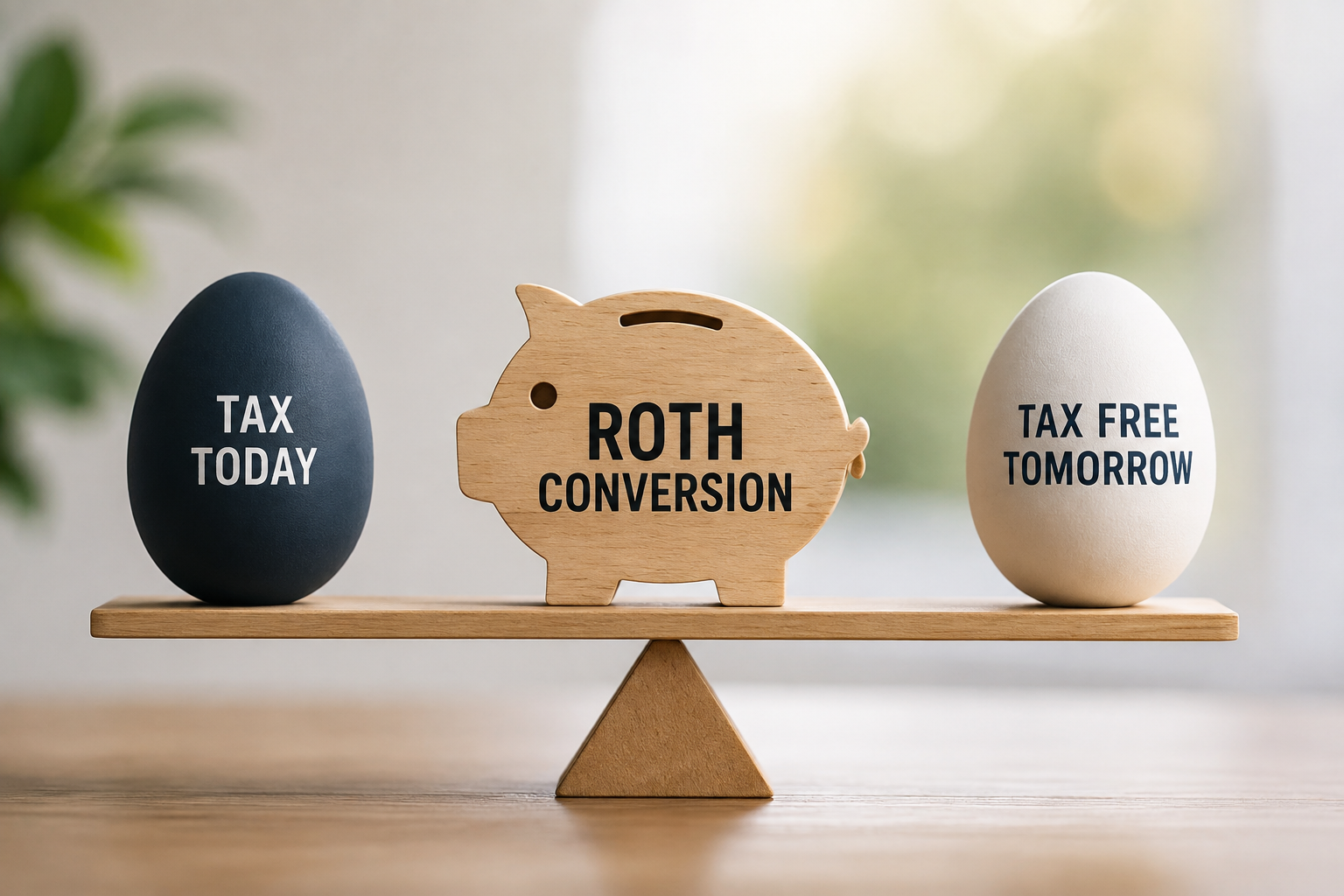
They’re designed to reduce your lifetime tax bill.
That’s an important distinction.
Paying a little more tax today may allow you to avoid much larger taxes later, especially if Required Minimum Distributions (RMDs), Social Security, investment income, and Medicare premiums begin stacking on top of one another.
The goal isn’t to find the lowest tax bracket this year. It’s to pay the lowest lifetime tax bill.
Your Retirement “Tax Window”
For many retirees, the years immediately after leaving work create a unique planning opportunity.
Your paycheck has stopped.
Social Security may not have started.
Required Minimum Distributions are still years away.
This often creates a temporary period of lower taxable income where Roth conversions can be completed at relatively favorable tax rates.
Once RMDs begin, however, much of that flexibility disappears because the IRS determines how much must come out of your traditional retirement accounts each year.
Tax Brackets Aren’t Something to Fear
Many investors view tax brackets as something to avoid.
Retirement planners often view them as something to use strategically.
Rather than converting an entire IRA in one year, many retirees gradually convert enough each year to “fill” their current tax bracket without spilling into the next one.
Instead of asking,
“How much can I convert?”
the better question becomes,
“How much room do I have left in my current tax bracket?”
That simple shift in thinking can significantly reduce taxes over time.
Market Declines Can Create Opportunity
Market corrections are uncomfortable—but they can also create planning opportunities.
Suppose your IRA declines from $1 million to $800,000 during a bear market.
Converting while account values are temporarily depressed means paying income tax on a smaller amount. If the market later recovers, that future growth occurs inside the Roth IRA, where qualified withdrawals are tax-free.
Nobody hopes for market declines.
But thoughtful planning can turn volatility into opportunity.
Roth Conversions Affect More Than Taxes
Taxes are only part of the equation.
A large conversion can temporarily increase Medicare Part B and Part D premiums through IRMAA. State income taxes, Social Security taxation, and even estate planning goals should also influence how much to convert—and when.
That’s why Roth conversions shouldn’t be evaluated in isolation. They work best as part of a broader retirement income strategy.
Not Everyone Should Convert
Roth conversions aren’t a universal solution.
For some retirees, remaining in a lower tax bracket throughout retirement makes conversions less compelling. Others may plan to relocate to a lower-tax state, expect lower future income, or need retirement assets for near-term spending.
The decision depends on your income, retirement timeline, tax projections, and long-term objectives.
The answer is rarely found in a rule of thumb.
The Bottom Line
A Roth conversion isn’t about avoiding taxes.
It’s about deciding when to pay them.
When used strategically, Roth conversions can reduce future Required Minimum Distributions, create greater tax flexibility, improve estate planning opportunities, and help manage lifetime taxes.
The IRS doesn’t care whether you pay taxes at age 60 or age 75.
Your job is deciding which year costs you less.
Call to Action
If you’re approaching retirement and wondering whether Roth conversions belong in your financial plan, don’t rely on generic rules of thumb or online calculators. The right strategy depends on your income, tax brackets, retirement assets, Medicare considerations, estate planning goals, and how all of those pieces fit together over time.
A multi-year tax projection can help identify whether you have an opportunity to convert at favorable rates—or whether waiting may be the better choice. If you’d like to explore how a Roth conversion could affect your long-term retirement plan, I’d be happy to walk through the numbers with you.