Taxes are one of the largest expenses most families will face over their lifetime. Whether you’re considering a Roth conversion, selling appreciated investments, exercising stock options, or planning retirement withdrawals, taxes can significantly affect the amount of wealth you ultimately keep.
It’s no surprise, then, that many investors turn to their financial advisor with tax-related questions. But that raises an important question:
Can a financial advisor legally provide tax advice?
The answer is more nuanced than most people realize. Understanding where financial planning ends and formal tax advice begins can help you avoid costly misunderstandings and ensure you’re receiving guidance from the right professional.
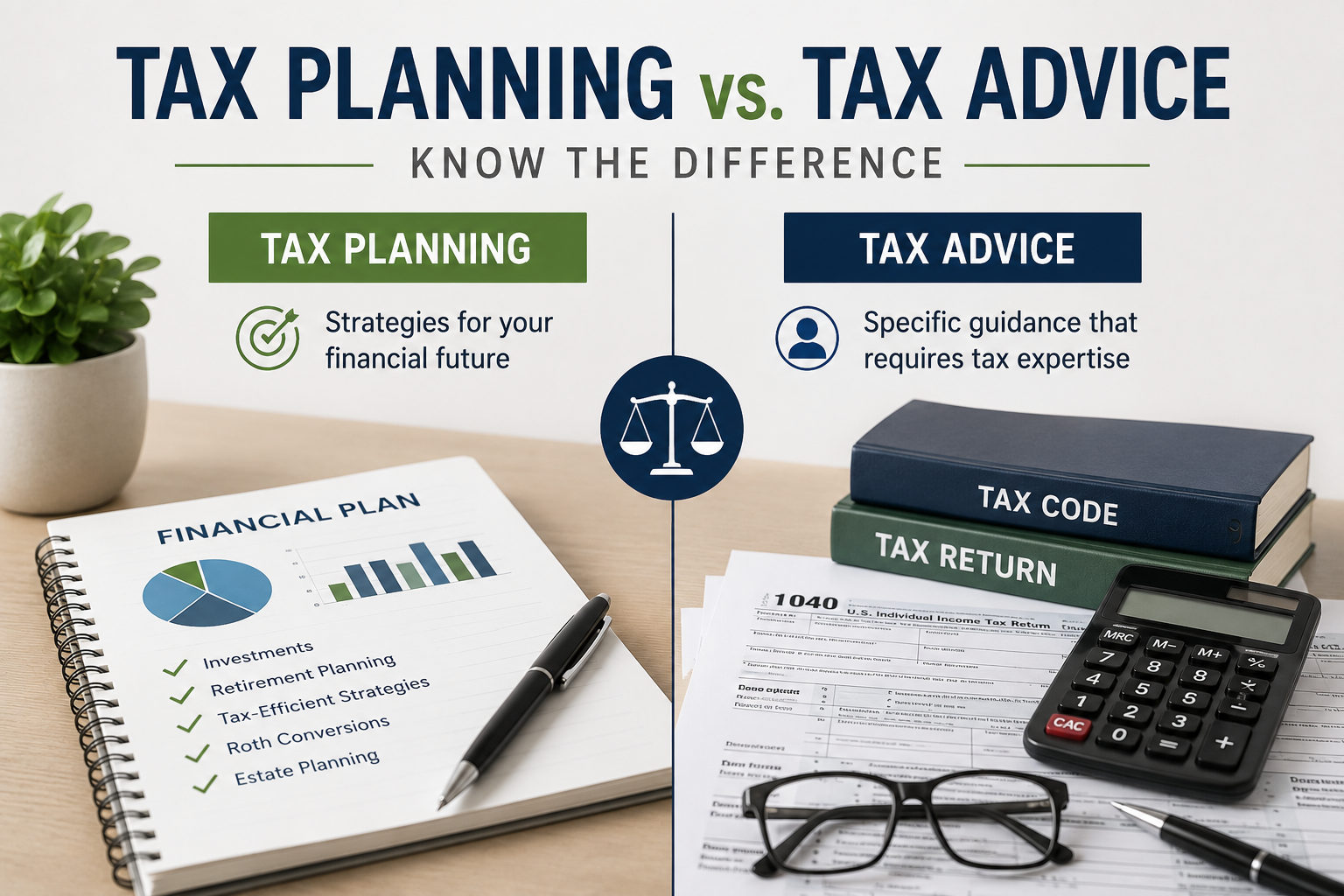
Tax Planning vs. Tax Advice
Financial advisors play an important role in helping clients make tax-efficient financial decisions.
For example, many advisors routinely discuss strategies such as:
- Roth conversions
- Tax-loss harvesting
- Tax-efficient retirement withdrawals
- Asset location strategies
- Charitable giving
- Capital gains management
These are all examples of tax planning—using the tax code to help clients make better financial decisions.
Formal tax advice, however, is different.
Preparing tax returns, interpreting complex sections of the Internal Revenue Code, representing taxpayers before the IRS, issuing written tax opinions, or advising clients on ambiguous tax positions generally requires additional professional credentials, such as a Certified Public Accountant (CPA), an Enrolled Agent (EA), or a tax attorney.
The distinction may seem subtle, but it exists to protect both investors and the professionals who advise them.
Why the Difference Matters
Financial advisors operate under strict regulatory and compliance standards. Most advisory firms prohibit advisors from providing formal tax advice because their licenses, insurance coverage, and regulatory oversight generally do not extend to tax practice.
That doesn’t mean advisors should avoid discussing taxes altogether. In fact, taxes are an essential part of comprehensive financial planning.
Instead, advisors should recognize where financial planning ends and where specialized tax expertise becomes necessary.
For clients, understanding this distinction helps set appropriate expectations and reduces the risk of relying on guidance that extends beyond an advisor’s qualifications.
The Best Financial Plans Coordinate Both Disciplines
A decision to convert part of an IRA to a Roth account affects both present and future tax brackets.
Selling appreciated investments can influence Medicare premiums, capital gains taxes, and Social Security taxation.
Exercising stock options may trigger additional ordinary income taxes.
Each financial decision has tax consequences.
That’s why the best outcomes often come from coordinated planning.
Sometimes that coordination occurs between a financial advisor and a CPA or Enrolled Agent. In other situations, investors work with professionals who possess expertise in both financial planning and taxation.
The important point isn’t whether one person performs every role, it’s ensuring that investment decisions and tax decisions are working together rather than independently.
The Value of Dual Expertise
Some financial professionals pursue additional education and licensing that allows them to provide both financial planning and tax services.
This integrated approach can offer several advantages.
When the same professional prepares your tax return and develops your financial plan, they already understand your income sources, deductions, investment holdings, retirement accounts, and long-term objectives. Rather than estimating tax consequences, they can often model planning strategies using your actual tax information.
For example, evaluating a Roth conversion, the sale of a rental property, stock compensation, or retirement withdrawal strategy becomes more precise when both financial planning and tax preparation are coordinated.
While this type of integrated service isn’t necessary for everyone, it can simplify decision-making for households with increasingly complex financial lives.
Choosing the Right Professional
The most important question isn’t whether your advisor prepares tax returns.
It’s whether your financial planning and tax planning are coordinated.
Ask questions such as:
- Who reviews the tax consequences of my financial decisions?
- Does my financial advisor communicate with my tax professional?
- Who is responsible for identifying tax-saving opportunities throughout the year?
- If my situation changes, who updates both my financial plan and my tax strategy?
Whether your advisor collaborates with a CPA or Enrolled Agent—or possesses both financial planning and tax expertise—the goal is the same: helping you make informed decisions while avoiding costly surprises.
The Bottom Line
Financial advisors should absolutely discuss taxes as part of comprehensive financial planning. However, formal tax advice and tax preparation generally require additional credentials and specialized expertise.
The most successful retirement strategies recognize that investment management, retirement planning, and tax planning are deeply interconnected. As discussed in our article on why investment, tax, and retirement planning should work together, the best financial decisions are rarely made in isolation.
Ultimately, investors shouldn’t simply ask whether their advisor can provide tax advice. They should ask whether the professionals guiding their financial future are working together to deliver advice that is coordinated, accurate, and aligned with their long-term goals.