
For decades, many investors followed a familiar formula for building wealth: stocks for growth, bonds for stability and income, and cash for short-term needs.
But in today’s market environment, that traditional framework is being tested.
Stocks continue reaching elevated valuations driven largely by a concentrated group of mega-cap technology companies, while bonds — historically viewed as a source of portfolio stability — have struggled under the pressure of inflation, rising interest rates, and economic uncertainty.
At the same time, investors are navigating:
- persistent market volatility
- geopolitical tensions
- rising government debt levels
- inflation concerns
- changing interest rate expectations
- increasing concentration risk within public markets
As a result, many investors are beginning to ask an important question:
“What other options exist beyond traditional stocks and bonds?”
That’s where alternative investments enter the conversation.
And despite the name, “alternative” investments are becoming increasingly mainstream in modern portfolio construction.
What Are Alternative Investments?
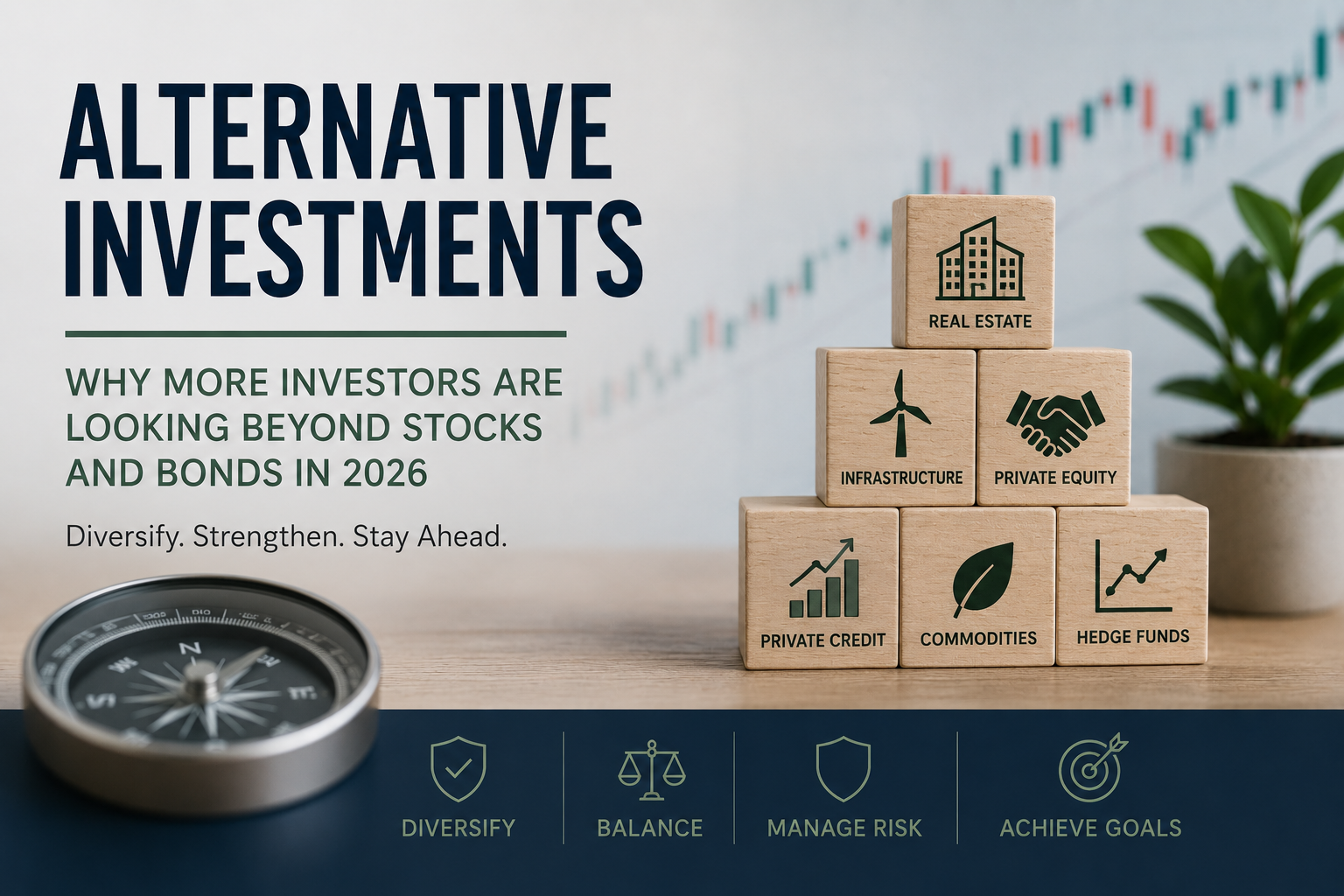
Traditionally, alternative investments refer to assets outside the standard categories of stocks, bonds, and cash – assets that are thoroughly analyzed by the CAIA Association, the premier global authority on alternative asset education.
Examples include:
- private equity
- private credit
- hedge funds
- real estate
- infrastructure
- commodities
- managed futures
Historically, these investments were often associated with institutional investors and ultra-high-net-worth individuals due to:
- high investment minimums
- limited access
- illiquidity
- complex structures
But that landscape has changed significantly over the past decade.
Today, many alternative strategies are accessible through:
- closed-end mutual funds
- exchanged traded funds
- private market platforms
- unit investment trusts
In many ways, the term “alternative” no longer fully reflects how widely these investments are being used.
Why Investors Are Rethinking Traditional Diversification
One of the biggest challenges facing investors in recent years has been the changing relationship between stocks and bonds.
Traditionally, bonds often helped stabilize portfolios during periods of stock market stress. But in inflationary environments, both stocks and bonds can struggle simultaneously — reducing the diversification benefits many investors previously relied upon.
At the same time, broad market indexes have become increasingly concentrated.
A growing percentage of major index performance has been driven by a relatively small group of large technology companies, leaving many investors more concentrated than they may realize.
This has caused some investors to reconsider whether traditional public markets alone provide enough diversification.
Alternative investments may offer exposure to:
- different return drivers
- private businesses
- real assets
- non-public income streams
- strategies less directly tied to daily stock market movements
The goal is not necessarily to replace traditional investments, but rather to complement them as a part of a broader investment management strategy designed around diversification, risk management, and long term financial goals.
Why “Alternative” Might Be an Outdated Label
Language shapes perception.
The word “alternative” can make these investments sound speculative, exotic, or excessively risky. But many of these asset classes have existed for generations and play a significant role in institutional portfolios.
Consider real estate, infrastructure, or private lending. These are not new concepts. In fact, many pension funds, endowments, and large institutions have utilized these strategies for decades as part of long-term diversified portfolios.
Today, individual investors are increasingly gaining access to some of the same tools previously reserved primarily for institutions.
That doesn’t mean alternatives are appropriate for everyone.
But it does mean the conversation around diversification is evolving.
Potential Benefits of Alternative Investments
Alternative investments may provide several potential benefits within a diversified portfolio, depending on the strategy and market environment.
Diversification
Some alternatives have historically shown lower correlation to traditional stock and bond markets, which may help reduce overall portfolio volatility.
Income Opportunities
Private credit, infrastructure, and certain real asset strategies may offer income streams beyond traditional fixed income investments.
Inflation Sensitivity
Real assets such as real estate, commodities, and infrastructure may respond differently during inflationary environments compared to traditional bonds.
Access to Private Markets
Many companies now remain private far longer than in previous decades. Private market investments may provide exposure to business growth opportunities unavailable in public exchanges.
Understanding the Risks
While alternative investments can offer potential benefits, they also come with important tradeoffs.
These investments may involve:
- lower liquidity
- higher fees
- valuation complexity
- limited transparency
- longer holding periods
- greater investment risk
Some alternative strategies can also behave very differently than traditional investments during stressed market conditions.
That’s why alternatives should not be viewed as magic solutions or guaranteed protection against volatility.
Instead, they should be evaluated carefully within the context of an investor’s:
- financial goals
- risk tolerance
- liquidity needs
- time horizon
- broader financial plan
The Growing Importance of Portfolio Flexibility
In many ways, today’s market environment is forcing investors to think more broadly about diversification.
For years, rising stock markets made traditional portfolio construction feel relatively straightforward. But periods of elevated inflation, interest rate uncertainty, and concentrated market leadership have reminded investors that diversification still matters — perhaps now more than ever.
Alternative investments are not about chasing complexity for the sake of sophistication.
They are simply additional tools that may help investors build more flexible and resilient portfolios over time.
Final Thoughts
The future of investing may look far different from the traditional “stocks and bonds only” approach many investors grew accustomed to over the past several decades.
As markets evolve, investors are increasingly exploring new ways to diversify risk, generate income, and reduce reliance on any single asset class or market environment.
Whether we call them “alternative investments,” “private markets,” or “diversifying strategies,” these investments are becoming an increasingly important part of modern portfolio conversations.
Because in today’s economy, diversification itself may need to evolve.