
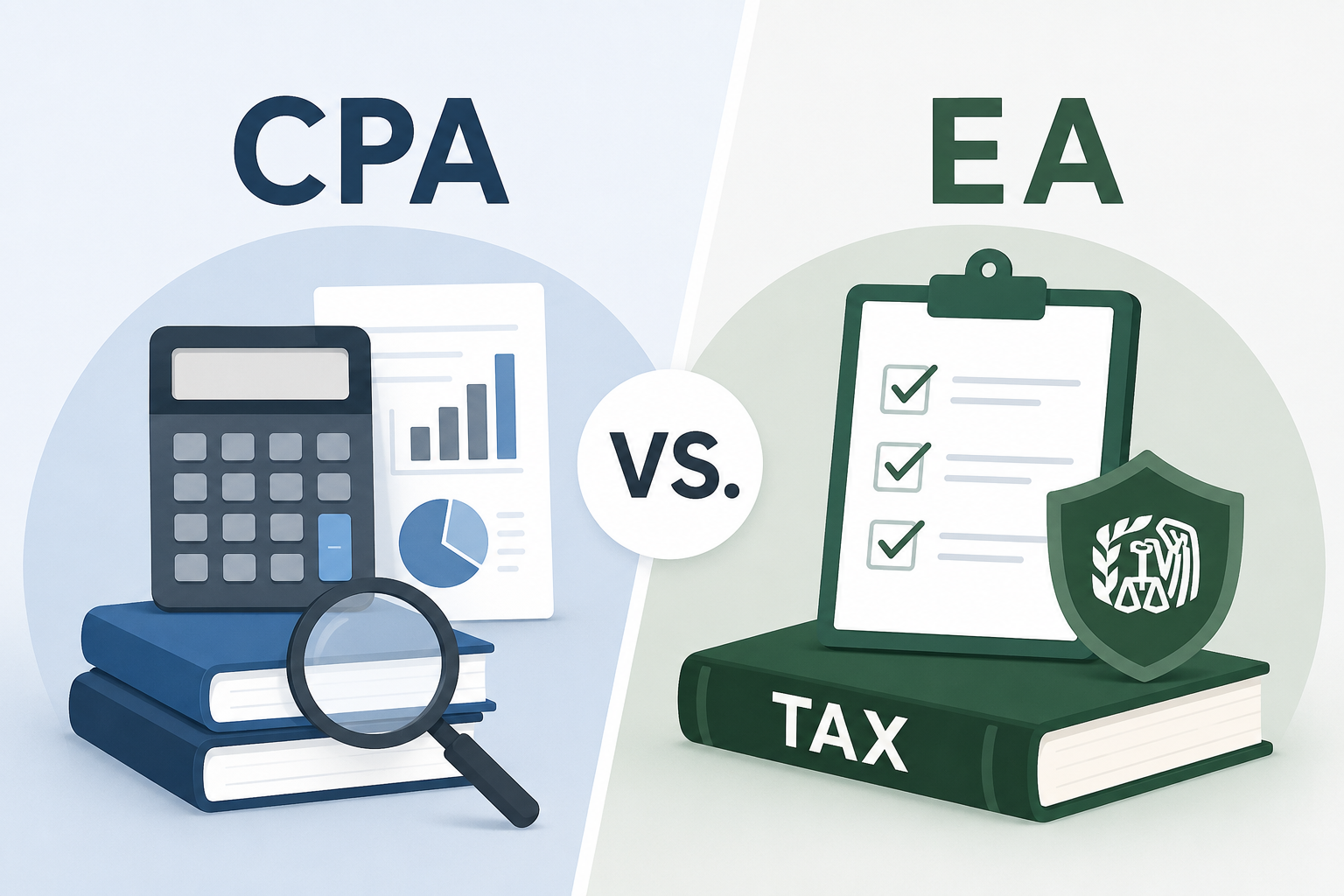
In our previous article, we discussed the difference between tax planning and formal tax advice. Once you’ve determined that you need professional tax advice, the next question becomes:
“Should I call a CPA or an Enrolled Agent?”
For many people, the answer seems obvious. If it involves taxes, they assume they need a CPA.
That assumption isn’t always wrong—but it isn’t always right.
In reality, both Certified Public Accountants (CPAs) and IRS Enrolled Agents (EAs) are highly qualified tax professionals. The difference isn’t who is “better.” It’s understanding what each professional specializes in and whether that expertise matches your specific needs.
What Is a CPA?
A Certified Public Accountant (CPA) is a state-licensed professional whose education and training covers accounting, financial reporting, auditing, business consulting, and taxation.
Depending on their practice, a CPA may specialize in:
- Tax preparation and planning
- Financial statement preparation
- Audit and assurance services
- Business consulting
- Accounting and bookkeeping
Many CPAs devote their careers to taxation, while others focus primarily on accounting, auditing, or financial reporting.
What Is an Enrolled Agent?
An Enrolled Agent (EA) is a federally licensed tax professional authorized by the U.S. Department of the Treasury to represent taxpayers before the IRS.
Unlike CPAs, whose practices may span many areas of accounting, EAs specialize exclusively in taxation.
Common areas of expertise include:
- Federal tax preparation
- Tax planning
- IRS audits and appeals
- Tax controversy and collections
- Individual and business tax returns
- Retirement and income tax strategies
Their practice is centered on the Internal Revenue Code and IRS procedures.
Where the Public Gets Confused
The CPA designation is one of the most recognized and oldest credentials in the financial world, and for decades many neighborhood CPA firms handled bookkeeping, accounting, and tax preparation under one roof. As a result, many people naturally came to associate the CPA designation with anything related to taxes.
That perception continues today.
But a professional designation doesn’t necessarily tell you what someone spends most of their day doing.
For example, one CPA may spend nearly all of their time performing audits or preparing financial statements for businesses. Another may devote their entire practice to sophisticated tax planning.
The same is true for Enrolled Agents. For instance, one EA may focus on small business compliance, while another concentrates on IRS representation, tax controversy or complex individual tax planning.
The important takeaway is that experience and specialization often matter more than the credential itself.
It’s worth noting that many outstanding tax professionals are CPAs, just as many outstanding tax professionals are Enrolled Agents. Neither designation guarantees expertise in a particular area of taxation—it simply reflects a different licensing pathway and scope of practice.
When a CPA May Be the Better Fit
A CPA may be an excellent choice if your needs extend beyond taxation, such as:
- Corporate accounting and financial reporting
- Reviewing or auditing financial statements
- Assurance work
- Tax planning integrated with broader accounting needs
When an Enrolled Agent May Be the Better Fit
An Enrolled Agent may be the better fit when your primary concern is federal taxation, including:
- IRS notices or representation
- Multi-state tax issues
- Tax planning focused on reducing current or future federal tax liability
- High level tax expertise at a lower price point
A Quick Comparison
| CPA | Enrolled Agent |
|---|---|
| Licensed by state boards of accountancy | Licensed by the U.S. Department of the Treasury |
| Can prepare tax returns | Can prepare tax returns |
| Can represent clients before the IRS | Can represent clients before the IRS |
| May perform audits and issue financial statements | Does not perform audit or attestation services |
| Practice may include accounting, auditing, consulting, or tax | Practice is dedicated to federal taxation |
The Bottom Line
Credentials tell you what someone is licensed to do. Experience tells you what they do exceptionally well.
CPAs who specialize in taxation may be an outstanding choice for sophisticated tax planning.
Likewise, Enrolled Agents whose practice is devoted entirely to federal taxation may be exceptionally qualified to help clients navigate complex tax codes, IRS procedures, and strategies aimed at improving tax efficiency.
The better question isn’t:
“Is this person a CPA or an Enrolled Agent?”
It’s:
“Does this professional regularly solve problems like mine?”